Electric Bill Demystifier
Your electric bill is confusing on purpose. Understand it, then compare plans to find the cheapest one.
Your Usage
Find this on the first page of your bill
Per-kWh Charges
These multiply by your usage (enter in cents, just like your bill)
Flat Monthly Charges
Fixed fees that don't change with usage
Surcharges & Credits
Extra fees or credits that trigger based on your usage
Charge example: "$9.95 fee when usage exceeds 1,000 kWh" — set to Charge, threshold 1000, Flat $, fee 9.95
Credit example: "$150 credit when usage exceeds 2,000 kWh" — set to Credit, threshold 2000, Flat $, fee 150
Where to Find Your Numbers
Here's a real rate plan document. Every plan has these same pieces — just look for the highlighted items below.
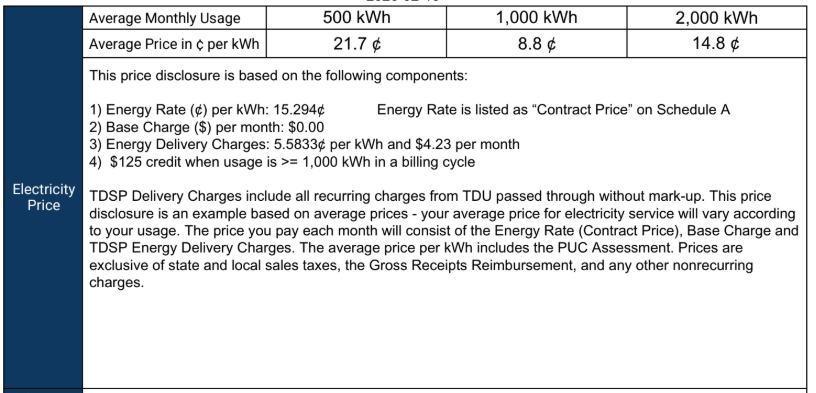
Energy Rate → Step 2
15.294¢/kWh — enter as 15.294 in "Energy Rate"
Delivery Charges → Steps 2 & 3
5.5833¢/kWh goes in Step 2, $4.23/mo goes in Step 3
Base Charge → Step 3
$0.00/mo here, but some plans charge $5–$15
Credit / Surcharge → Step 4
$125 credit when ≥ 1,000 kWh — set as Credit, threshold 1000
How to read your rate plan
- Energy Rate (per kWh): The cost of the actual electricity. Usually listed as "Energy Charge" or in cents/kWh (e.g., 10.943¢/kWh).
- Delivery Charge (per kWh): What the utility charges to transport electricity to your house through their wires. Often called "Transmission" or "Distribution."
- Flat Delivery Fees: Fixed monthly charges just for being connected — you pay these even if you use zero electricity.
- Surcharges & Add-ons: Extra fees triggered by conditions like exceeding a usage threshold, renewable energy programs, or seasonal adjustments.
- Credits: Some plans give you money back! For example, a $125 credit if you use over 1,000 kWh. These subtract from your total. Use the Credit (−) dropdown in Section 4.
Your Last 12 Months of Usage
Enter the kWh from each month on your past bills
Your Rate Plans
Build each plan using the same charge types from the Calculator tab